
By Alexa Ferrone, Marketing Associate at Chicory
When Chicory fielded its New Year, New You survey of 793 U.S. consumers in September 2026, the data was clear: the January shopper knows exactly what they want, but has not decided who provides it.
That tension defines the season. Shoppers head into the 2027 new year with specific, quantified goals and a shopping list already written. However, they are more willing to switch brands than at any other point on the calendar. For CPG brands, January is the rare window where precision and openness exist in the same shopper.
The January Reset is Bigger than brands expect
Half of consumers enter the new year working toward a specific outcome, and another quarter are making better choices without a set goal. Only 4% are planning no changes at all.
This is an almost universal window of opportunity. Products introduced in January are judged on whether they fit pre-set goals. Habits don’t count as much as they usually do.
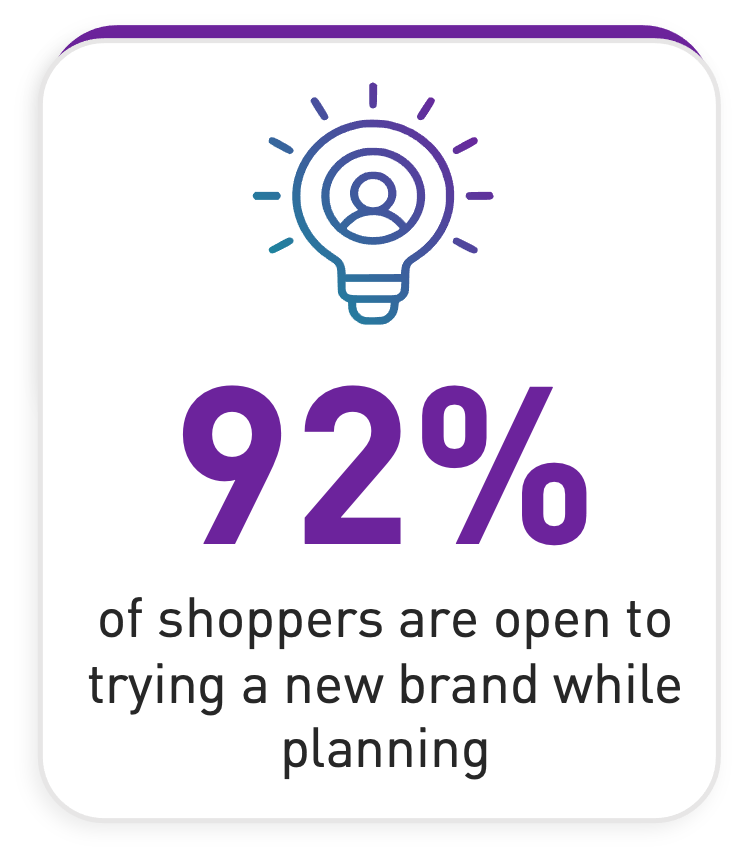
92% of consumers say they are at least somewhat open to trying a new brand while in planning mode, the stretch when they are browsing recipes, building lists, and mapping out meals. Half describe themselves as very open. A year ago the combined figure was 94%, per Chicory’s New Year Survey from last year. Two separate samples landing within two points confirm this as a structural feature of the season.
The reset is on both sides of the cart. The cut list is run by sugar, with sweet snacks leading at 54%, sugary drinks at 48%, and ultra-processed foods at 42%.
the season of benefits claims
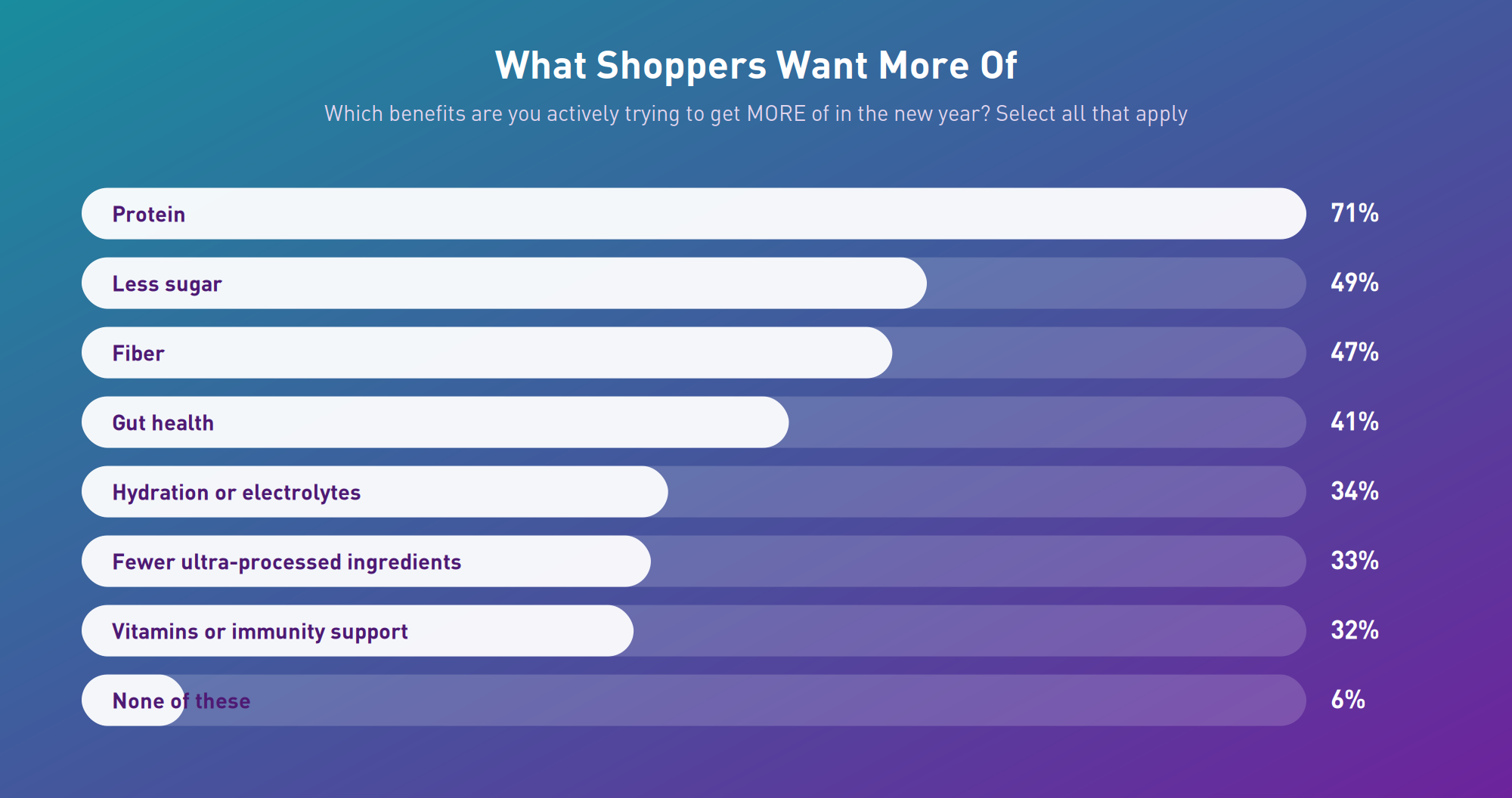
Protein is the defining benefit of the season. 71% of consumers are actively trying to get more of it, clearing the next benefit by 22 points. Less sugar is at 49%, fiber at 47%, and gut health at 41% form a second tier.
How shoppers satisfy those goals is where the opportunity sits. Two thirds get protein primarily from whole foods and 58% reach for food before supplements. Everyday products with added protein are the primary source for 11%.
Fiber is the more open door. Added-fiber products reach 16% of fiber sourcing, five points higher than protein, and fiber is the benefit shoppers are least sure how to hit on their own. A fiber claim has more room to win a spot in the basket than a protein claim competing with whole foods like chicken and eggs.
70% of consumers say a specific callout makes them more likely to buy, rising to 80% among shoppers aged 30 to 44. Only 6% read it as a marketing gimmick.
the list gets written before the trip
Most of the January cart is decided before anyone reached the store. 58% of consumers plan meals or build detailed shopping lists in advance, and 42% browse recipes or food content online before they shop.
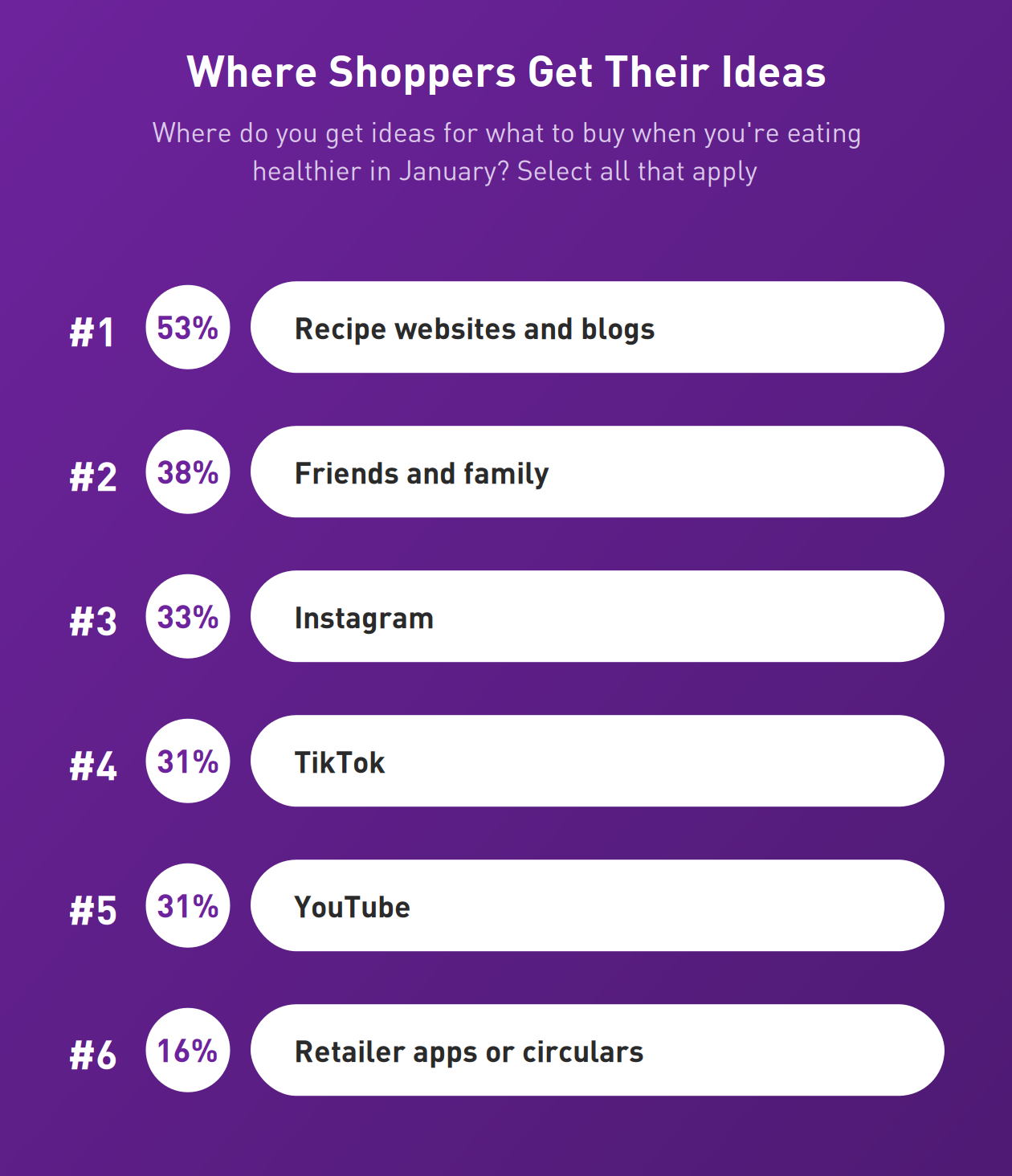
Recipe websites and blogs are the single largest source of ideas for healthier eating in January at 53%, ahead of other social platforms. Friends and family follow at 38%, Instagram at 33%, and TikTok at 31%.
Retailer-owned channels sit far lower. Retailer apps and loyalty offers reach 16%, and in-store displays 13%. The ideas that shape the January basket form well before the shopper gets to the retailer. It takes shape inside the content shoppers are already reading, while they are still deciding. Meeting them in that moment reaches an active mindset. By the time they are in the aisle, most of the spots are taken.
budgets reroute health goals
Only 11% of consumers plan to scale back their health goals because of cost. Everyone else keeps the goal and changes how they reach it.
55% will buy store-brand versions of healthy products, 39% will lean harder on coupons and promotions, and 33% will cook from scratch instead of buying convenient, healthy products.
When the healthier option costs more, 45% of consumers look for a cheaper store-brand version with the same benefit, but 36% pay the premium anyway. Only 7% walk away from the benefit entirely. 93% still buy the benefit in some form, and the competition is over whose version ends up in the cart.
Shoppers told us what makes them try a new product. A discount or coupon leads at 53%, but seeing a product featured in food content a shopper is already reading follows at 44%, and a creator recommendation at 43%. Relevance performs close to price without costing margin.
Where Chicory Fits in for 2027
The new year shopper is precise about the outcome and undecided about the brand. They have a protein target, a list, and a price ceiling, and they built all three before they reached the store.
That makes the planning window the decisive moment. A shopper researching how to hit a protein target, building a list in an app, or looking for lower-sugar swaps is already in an active mindset. Brand preference is formed in that window.
Chicory is a contextual advertising platform built exactly for reaching consumers in those high-intent moments.
Ready to reach new year shoppers before their lists are set? Book a meeting today.
Methodology: Chicory conducted an online survey in September 2026 of 793 U.S. consumers ages 18 to 85. The margin of error is +/- 3.48%.
More Blogs


GLP-1 medications have moved well beyond early adopters. 38% of consumers are currently on one, and their grocery habits look meaningfully different from everyone else's. They're buying more protein and produce, cutting back on snacks and alcohol, cooking more at home, and planning to stay on these medications for the long term.